← PortfolioUXPin · 2010 — 2020

The Enterprise Pivot

How I started a company on a paper notepad, evolved it into a profitable enterprise business, and led it to acquisition.

Co-founder, CEO & VP of Design

The Enterprise Pivot
0 → 100+
Employees, two global hubs
48h
First batch sold out
Samsung, TATA
Panasonic — enterprise contracts
2020
Acquired by Xenon Partners

From a notepad

UXPin did not start as software. It began as a physical product, born out of my own explorations into how to better support cross-functional collaboration. In 2010 I designed a paper prototyping notepad to help teams sketch together.

We put it online and the initial batch sold out in 48 hours to over 400 customers. That immediate, tangible validation proved we had struck a real nerve in the market.

The first UXPin product — a paper prototyping notepad, 2010.

From paper to digital

In 2011, encouraged by the traction, we decided to build a software version of UXPin — a design collaboration tool.

I came up with the idea of using advanced (for 2011) computer vision to automatically transform paper prototypes into HTML. The feature was applauded by the media and resulted in near-zero traction on the market. It was an invaluable lesson in focusing on the real problem instead of hype features.

Press loved it. The market did not.

Relentless customer obsession

So I learned to truly listen, and built the company culture around relentless customer obsession. Customer support became the heartbeat of the company.

I knew the first 100+ UXPin customers personally. I read all the support emails in the early days, and we prioritized our feature backlog using quantitative analysis of customer tickets cross-checked with qualitative insights.

Customer feedback was sacred. If a customer needed help we would always go the extra mile — prepare custom tutorials, jump on support calls, aid them in their design work. Every interaction was a lesson and an opportunity to build a relationship. It is how I learned to listen to the market instead of pushing flashy features — and it took us to becoming the first Polish company with Silicon Valley funding.

Know your customers. Work for your customers.

It’s time for enterprise

In 2015 our growth was rewarded: we raised our Series A and immediately set our sights on the enterprise market.

I quickly realized that scaling up meant changing the company from the ground up. It was an enormous challenge that stretched me as a design, product and business leader.

Series A — and a decision to rebuild the company around enterprise.

The transformation

Product: the product had to mature to become enterprise ready. I made the bold call to invest in a full overhaul of our rendering engine so it could handle much bigger projects and far stricter reliability requirements. 60% of our engineering team was devoted to that effort for 12 months.

Design: to support enterprise processes we had to design for continuity across complex workflows. I also wanted the team to aim high and create a design that would communicate a sense of everlasting quality.

Organization: in 24 months we went from thousands of small subscriptions to six-figure contracts with companies like Samsung, TATA and Panasonic. From sales and GTM to forward-deployed engineering, I more than doubled the organization, built the executive team, and extended our culture of excellence across two sizable hubs — Mountain View and Gdańsk — collectively employing over 100 people.
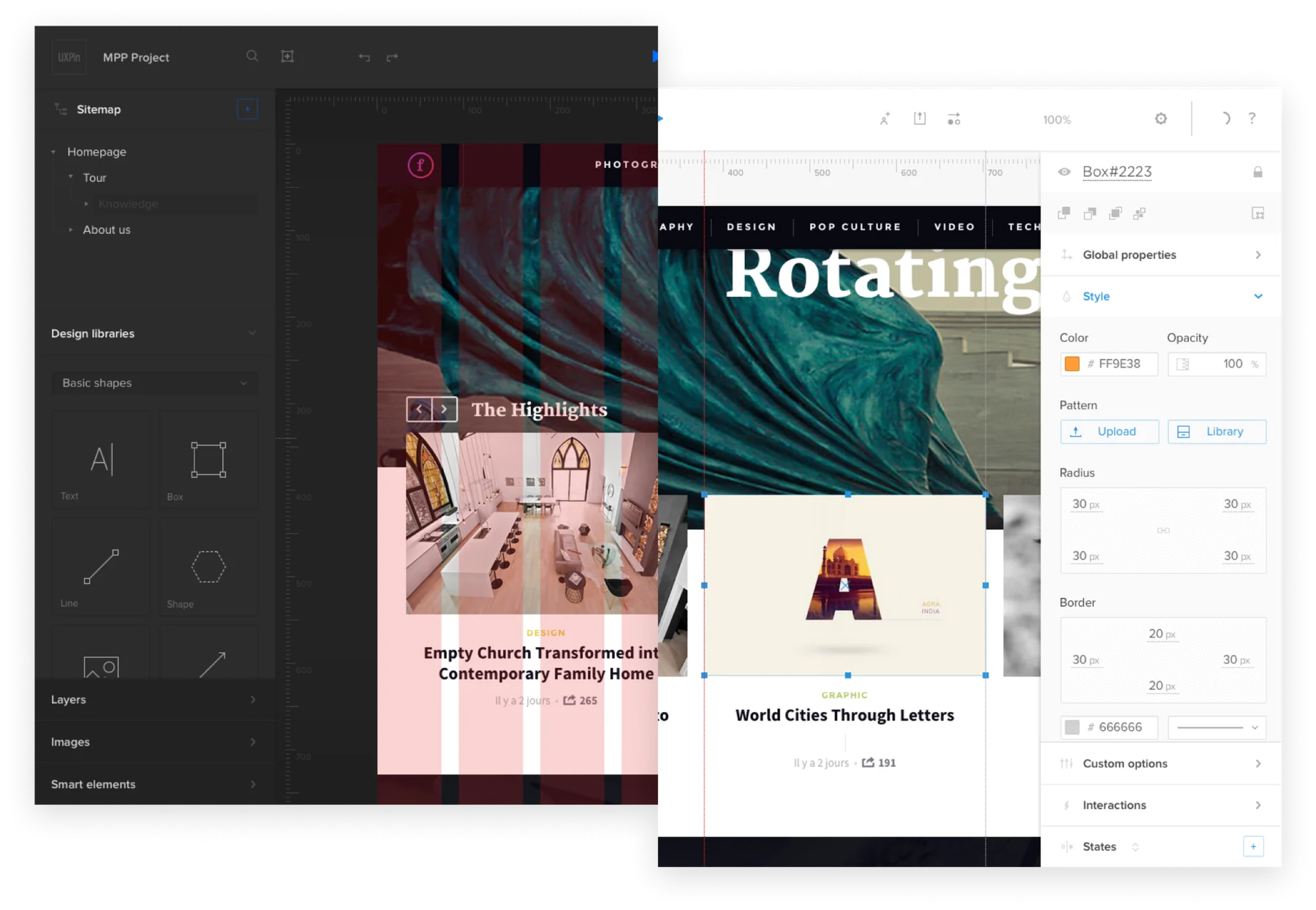
Design is the soul of the product

To set our design and engineering teams on the right track, I workshopped with them the set of principles that would define the timeless quality we wanted to embody in the new version of the product. I also jumped into UXPin itself to share my explorations of a new, minimalist design language.

In 2016 UXPin shipped as a completely redesigned, enterprise-grade product. Over ten years later, under new post-acquisition management, UXPin still looks and feels the way it did in 2015 — and it does not feel dated.

From the archive — the design principles I defined with the team.
The completely redesigned, enterprise-grade product. Shipped 2016.

Connecting to real workflows

A new engine, new features and a new UI were not enough. Great enterprise products have to connect to the workflows customers already have.

In parallel to the overhaul of the core experience, I led the exploration of partnerships that would let UXPin plug into existing enterprise tools. The first two deals were with Jira and Adobe Typekit — now Adobe Fonts. Both played a significant role in our ability to sign enterprise customers, and I led product strategy and business development for both.

UXPin + Adobe Typekit — plugging into the tools enterprises already used.

The reshuffle

In just a few years the market of design tools underwent a complete reshuffle. Figma emerged as the strong market leader and eventually IPO’d. Our main competitor for many years, InVision, went bankrupt. And I decided it was time to sell UXPin to a private equity firm.

How did it happen? Figma made a bold bet on WebAssembly, a new technology that offered them unparalleled performance and reliability. They reached a level of excellence that UXPin and InVision were unable to match.

I hesitated when there was a moment to act, and I stuck to the older technology — indirectly tied to our enterprise contracts. My lack of courage limited our ability to realize our potential. It was the most important leadership lesson I have ever received.

The silver lining

Innovation made the difference between an acquisition and bankruptcy. While many of our competitors went out of business, I sold UXPin — and it continues to operate today, now celebrating its 16th year.

In the heat of our enterprise transformation I created a center of innovation at the company. Every quarter I would form an impromptu cross-functional team reporting directly to me, with the purpose of building things we would otherwise hesitate to invest in.

One of those innovation products — UXPin Merge, a bridge between production code bases and the design tool — became a massive success, and the main reason we were acquired.

The team

Above everything else, we built an amazing, high-performing, happy team. That is the part I am proudest of.

The UXPin team — the thing I am proudest of building.

Lessons learned

  • Growing leaders grows the company.
  • Culture breeds velocity and innovation.
  • Disrupt yourself, or be disrupted.
Next project

eCommerce Video Portal

Grupa Nokaut · 2011 · Head of Design · R&D team

← All work